

The Use of the Old Testament in the New
By Dr. David L. Burggraff
Professor of Historical & Systematic Theology and Hermeneutics at Shepherds Theological Seminary in Cary, NC; PhD Dallas Theological Seminary.
One of the most important issues throughout the history of biblical interpretation has been the relationship of the Old Testament (OT) to the New Testament (NT). Indeed, the first paragraph of the massive Dictionary of the New Testament Use of the Old Testament (2023) so states,
In the last few decades, the field known as “the use of the Old Testament in the New Testament” has blossomed. What was peripheral in the past has now taken center stage…NT scholars are growing more aware of how NT authors, at key points in their arguments, often lean on specific OT passages, events, and concepts.[1]

The use of the OT in the NT is at the very heart of the ongoing debates between the Dispensational and covenantal systems of theology, and has significance also for Christology, inerrancy, and a host of other topics. One of the essentials of Dispensationalism, as noted by Charles Ryrie in his book Dispensationalism (2007), is that “the essence of Dispensationalism, then, is the distinction between Israel and the church.”[2] Dr. Ed Glenny thus states,
The use of the Old Testament in the New is one of the most fruitful and promising areas of study for evangelical scholars today. It is at the center of current discussion concerning hermeneutics, inerrancy, and the relationship between the Testaments. The application to the church of Old Testament passages that speak of the nation of Israel is also an important factor in the question concerning the relationship of Israel and the church.[3]
This is not simply some esoteric topic only discussed by heady-minded scholars. It is central to the positions and beliefs we hold relative to our understanding of God’s biblical covenants, redemption, fulfillment of prophetic events, doctrine of the church, the two ordinances, kingdom of God, etc. The questions raised by scholars are complex. Is it accurate to claim that the OT quotations in the NT are inexact? Did the NT authors, who were first-century Jews, utilize contemporary methods such as midrash and allegorical interpretation? Do the NT writers incorrectly identify Christological fulfillments? Does Paul improperly allegorize the Scriptures? In numerous places it seems that the NT writer is giving an interpretation to OT fulfillment passages different from the original intention of the OT writer.[4] Should Jesus’ and the NT writers’ approach to the OT provide the standard and pattern for our own exegesis? To put the question in a different form, “Are we free to reproduce the exegesis and hermeneutical methods of the NT today?” What is the explanation of these NT passages? To such questions, there is no consensus among scholars concerning the use of the OT in the NT. Our interest—and purpose of this article—is to see how the NT used the OT, in terms of attitudes toward and methods of drawing upon, exegeting and applying its methods.
The Range and Authority of OT References in the NT
Range of OT References
The NT contains at least 295 unquestionable separate references to the OT, according to Roger Nicole, as well as many allusions. Nicole observed that the 295 OT references occupy 352 NT verses (4.4% of the entire NT).[5] Michael Vlach has identified approximately 350 quotations. Vlach notes, “If pushed for specificity, I estimate 355-360, which is higher than most scholars would agree. Most agree that there are approximately 300 to 360 quotations of the OT in the NT.”[6]
In addition to the quotations, “allusions” are difficult to determine in number. Some lists count anywhere from 400 to 4,000 allusions of the OT in the NT. Nicole observes, “It can therefore be asserted, without exaggeration, that more than 10 percent of the New Testament text is made up of citations or direct allusions to the Old Testament. Of the thirty-nine books of the OT, only nine are not expressly referred to in the NT.”[7] Consequently, there is a significant body of literature illustrating the interpretive methods of Jesus and the New Testament writers.[8] Thus, deter- mining the exact number of quotations and allusions is not critical for under- standing the issue. How they are used is, which leads us to the matter of authority.
Authority of the OT References
The OT was the Bible of Jesus and the early disciples. They believed it, quoted it, and interpreted it. Several conclusions can be drawn from an examination of Jesus’s use of the OT. The gospel accounts record Jesus consistently treating the OT historical narratives as straightforward records of fact.[9] Jesus often chose as the basis of His teaching those very stories that most modern critics find unacceptable. The allusions to Abel, Noah, Abraham, Isaac, Jacob, and David, for example, all seem to be intended and were understood as references to actual people and historical events. When Jesus applied the historical record, He drew it from the plain meaning of the text. His way of reading the OT angered the religious authorities. Jesus denounced the caustic methods of certain religious leaders that set aside the very Word of God they claimed to be interpreting and replaced it with their own traditions (Mt 15:1-9; Mk 7:6-13). Yet following His resurrection, Jesus also revealed content throughout the OT, both Moses and the Prophets, spoke truly about Himself (Lk 24:25-27).
The apostles followed their Lord in regarding the OT as the inspired Word of God (2Ti 3:16; 2Pe 1:21). In at least fifty-six instances, God is explicitly referred to as the Author of the biblical text. Like Christ, they accepted the historical accuracy of the OT (e.g., Ac 7:9-50; 13:16-22; Heb 11). As Roger Nicole observes,
They appeal to Scripture when in debate; they appeal to it when requested to answer questions, whether serious or captious; they appeal to it in connection with their teaching even to those who would not be inclined to press them for other authorities than their own word; they appeal to it to indicate the purpose of some of their own actions or their insights into God’s purpose in relation to contemporary developments; and they appeal to it in their prayers.[10]
The NT writers ascribe unqualified authority to the OT. By quoting the OT so frequently, the NT writers demonstrated their trust in the absolute authority of the OT. Nowhere does a NT writer question or repudiate the truth of the OT passage he cited.[11] The high esteem with which the NT writers regarded the OT strongly suggests that they would not consciously or intention- ally have misinterpreted the words that they believed God himself had spoken.[12]
It is noteworthy that the whole NT contains not even one explicit citation of any of the Old Testament Apocrypha, which are considered canonical by the Roman Catholic Church.[13] Such an omission by Jesus in his quotations of the OT or by the authors of the NT canon can scarcely be viewed as accidental.[14]
The Accuracy of the OT References in the NT
Since the writings of the OT and the NT are inerrant (2Ti 3:16, 17; 2Pe 1:20, 21; Jn 17:17), the freedom displayed in the use of the OT in the NT raises many hermeneutical questions. One of the most frequently asked is: When quoting the OT, the NT frequently modifies the original wording. How can that practice be justified hermeneutically?
In some places where the NT authors quote the OT, they appear to modify the original wording. Variations in the OT text quoted in the NT are often used to undermine the Bible’s inerrancy and authority. Furthermore, to some critics, these alterations of the Hebrew text indicate nonauthentic and nonauthoritative uses of the OT by the NT, thus eliminating elements of true prophetic fulfillment. This problem can be answered on the linguistic and conceptual level. Richard Longnecker, Roger Nicole, and John Wenham suggest the following linguistic solutions.
First, there were several Hebrew, Aramaic, and Greek versions of the biblical text circulating in Palestine at the time of Christ, not all of which had the same wording. Keep in mind that differences in versions may have been a result of corruption in transmission of the copies of the Septuagint (LXX), although oftentimes the LXX reflects the original text.[15] The NT writers often had to then translate their quotations from these different texts. Although a given quotation from one of these versions might not have the same wording as the texts from which our current translations are made, they still represent a faithful interpretation of the biblical text available to the NT writer. Let’s not forget that the Holy Spirit was guiding these NT authors at this time (2Pe 1:20-21); “The Spirit of God was free to modify the expressions that He inspired in the Old Testament.”[16]
Second, as John Wenham notes, it was not necessary for the writers to quote OT passages word for word unless they claimed to be quoting verbatim, particularly since they were writing in a language different from that of the original OT texts.[17] The NT some- times paraphrased their quotations (as we often do when we preach!). The NT writers often simply allude to the OT passages without trying to quote them, or the writers may have recorded quotations made by others. Furthermore, the NT writers did not have the same rules for quotations as are enforced nowadays in scholarly works.[18]
Third, in ordinary life, freedom from quotations is a sign of mastery of one’s material; the more sure speakers are that they understand an author’s meaning, the less afraid they are to expound those ideas in words that are not exactly those of the author.[19] Hence, the fact that the NT writers sometimes paraphrased or quoted indirectly from the OT in no way indicates that they were using inaccurate or illegitimate interpretive methods.
Approaches to NT Use of the OT
The NT usage of the OT that prob- ably raises the most questions with regard to hermeneutical methodology (the exegesis of OT and NT passages) involves fulfillment passages. In places it sometimes seems the NT writer is giving an interpretation to these verses different from the original intention of the OT author.
It appears that three significant questions are at the heart of the issue of the OT usage in the NT. (1) What effect did noncanonical phenomena such as Jewish intertestamental theology and Jewish hermeneutics have on the apostolic understanding of the OT? (2) What effect did the events of Jesus’s life and ministry, especially His death, resurrection and ascension have on the apostolic understanding of the OT? (3) If former revelation lays the foundation for later revelation (a basic tenet of Dispensationalism), what influence does later revelation (i.e., the NT) have on earlier revelation (i.e., the OT)? Is typology a legitimate hermeneutical answer?
Jewish Background, Hermeneutical Terms and Resultant Issues
It’s helpful to have a little historical background and understanding of a few hermeneutical terms relative to this discussion. At the time of Christ, Jewish methods of interpretation could be classified into four main types: literal, midrashic, pesher, and allegorical.[20]
- The literal method of interpretation, referred to as peshat, apparently served as the basis for other types of interpretation.
- Midrash comes from the Hebrew verb darash, meaning “to search.” Midrash, then, speaks of an inquiry or an exposition. The primary goal of midrash was to highlight and explain the relevance of scriptural teaching in new and changing circumstances. Much of this midrashic interpretation is recorded in the Mishnah, a collection of rabbinic commentaries compiled around AD 200, and in the Babylonian and Palestinian Talmuds. By focusing on the identification of hidden meanings, midrashic exegesis often lost sight of the literal meaning of the text.
- Pesher interpretation was practiced primarily among the Qumran community. This form borrowed extensively from midrashic practices but included a significant eschatological (end-time) focus. The community believed that everything the ancient prophets wrote had a veiled prophetic meaning that was to be imminently fulfilled through their community.[21] Pesher interpretation was often denoted by the phrase “this is that” indicating that “this present phenomenon is a fulfillment of that ancient Prophecy.”
- Allegorical interpretation was based on the idea that beneath the literal meaning of Scripture lay the true meaning.[22] Historically, allegorical interpretation had been developed by the Greeks because the myths about their gods contained much that was immoral or otherwise unacceptable; that is, the myths were to be under- stood not literally but as stories whose real truth lay at a deeper level. At the time of Christ, Jews who wished to remain faithful to the Mosaic tradition and yet adopt Greek philosophy were faced with a similar tension. Some Jews resolved this by allegorizing the Mosaic tradition. Philo (ca. 20 BC – AD 50) is well known for this.
As far as Jewish hermeneutics are concerned, it seems the NT writers employed some of the techniques of Jewish hermeneutics. It is evident that the NT authors, who were first- century Jews, utilized peshat (literal interpretation) in their interaction with the OT. However, the key hermeneutical perspectives found in the NT (i.e., Christological perspective, corporate solidarity, presence of a divine pattern) did not come from Jewish hermeneutics, but rather from the OT or the events of Christ’s life (for example: the expanding picture—through progressive revelation—of the Messiah; He is not just a victorious king but also a sufferer). Apparently, these events gave the apostles a more complete understanding of the OT promises and prophesies concerning Christ. (Note: Jn 2:22; 12:16; 20:9; Lk 24:25-26, 44-45, and esp. Lk 4:18-19; see also Ps 2:1-2 with Ac 4:25- 31, where the use of Lord now refers to Jesus, not YHWH). We should avoid an excessive or unclear identification between the hermeneutics of early Christianity and first-century Judaism.
Non-Dispensationalist Approach
Was Jesus’ and the NT writers’ use of OT quotations and allusions intended to serve as a normative hermeneutical method and give interpreters in the post-apostolic times a pattern for their own exegesis? To put the question in a different form, “Are we free to reproduce the exegesis and hermeneutical methods of the NT writers today?”
We need to recognize that the early church fathers (e.g. the Patristic era), in the main, were chiliasts (premillennial in their eschatology) while at the same time many were supersessionists (that the Church replaces Israel; also known as replacement theology). Today, many non-Dispensationalists believe that the Church has replaced Israel. They arrive at that conclusion by claiming that through typology many of the OT references to Israel are to be understood as typological of the Church.
Many covenantalists claim that they consistently interpret literally. But their understanding of how literal hermeneutics operates is different. When covenantalists claim to interpret the Bible literally, they mean that they interpret the Bible non-allegorically and in accordance with the intended meaning of the author, which allows for figurative or symbolic language, opening up the possibility of a non-literal or spiritual interpretation, especially in regard to OT prophetic texts. They argue that literal interpretation demands that many of the Old Testament references to Israel are to be understood as typological of the Church. Consequently, even on a literal interpretation, given the principle of typology that Dispensationalists certainly accept, many of the Old Testament references to Israel are to be interpreted as referring to the Church. If both systems affirm a historical-grammatical interpretation, what accounts for the differences between them? The answer by most writers is explained as the priority given to either the OT or NT. Benjamin Merkle explains,
While Dispensationalists and covenantalists agree that the New Testament fulfills the Old Testament, the latter [covenantalists] tend to emphasize that the New Testament has priority for understanding the Old Testament, and the former [Dispensationalists] start with the Old Testament and move to the New Testament but caution against reinterpreting the Old Testament in light of the New Testament. . . Since covenantalists tend to emphasize the priority of the New Testament, they allow later revelation to shape their understanding of the Old Testament.[23]
The issue of NT priority over the OT has been espoused by non-Dispensationalists for decades. This thinking appears in George E. Ladd’s work when he writes,
The fact is that the New Testament frequently interprets the Old Testament prophecies in a way not suggested by the Old Testament context… The main point… is that many Old Testament passages which applied in their historical setting to literal Israel have in the New Testament been applied to the church. The Old Testament did not clearly foresee how its own prophecies were to be fulfilled. They were fulfilled in ways quite unforeseen by the Old Testament itself and unexpected by the Jews… The Old Testament is interpreted by the New Testament. … Here is the basic watershed between a Dispensational and a non-Dispensational theology. Dispensationalism forms its eschatology by a literal interpretation of the Old Testament and then fits the New Testament into it. A non-Dispensational eschatology forms its theology from the explicit teaching of the New Testament.[24]
Similarly, Ken Gentry, representing a traditional covenant approach, believes that “the Christian exegete must allow the New Testament to interpret the Old Testament. . .. This approach to biblical interpretation allows the conclusive revelation of God in the New Testament authoritatively to interpret incomplete revelation in the Old.” This would be a sound statement if Gentry meant that Scripture was expanded down through history (progressive revelation) as more details and explanation are added in such a way as not to change the meaning of an original OT passage through reinterpretation in the NT (i.e., the Church replacing Israel in the OT passages). But that is not what Gentry means. His approach is a so-called “grammatical-historical-theological” hermeneutic, whereby it is believed that the New Testament gives a theological basis for changing the original meaning of the Old Testament.[25]
The assumption by non-Dispensationalists is that the NT must interpret/reinterpret the OT. The failure of non-Dispensational interpretation at this point is that its view of typology (or better, its misunderstanding of typology) ignores or minimizes the meaning of the OT passage in its own context. Conversely, they misrepresent the hermeneutic of Dispensationalism by claiming it gives priority to the OT over the NT. Such is not the case. Michael Vlach, in his defense of Dispensationalism, explains:
Dispensationalists hold to “passage priority” in which the primary meaning of a passage is found in the passage at hand and not in other passages. Dispensationalists do not believe in the priority of one testament over the other (although the New Testament is more complete), they just ask that the integrity of each passage in each testament be honored without overriding its meaning in other passages. The New Testament will offer newer revelation, but it will not contradict or override the meaning of previous passages in the Old Testament.
Non-Dispensationalists often state that the real meaning of Old Testament passages is found in the New Testament. Allegedly, the New Testament and the “broader canon” give the real meanings of Old Testament texts, which can be different from the original meaning.
Dispensationalism asserts “passage priority.” This means that meaning of any Bible passage is found in that passage… That is why God placed that text in the Bible. Later revelation might comment on a passage, draw principles or significances from it, or connect a promise in the Old with fulfillment in the New, but later revelation does not reinterpret or change the meaning of earlier revelation…Divine inspiration guaran- tees this…The unity of Scripture applies to the relationship between the Old and the New…All Scripture is inspired and contributes to God’s story. And since God is the Author of all Scripture, there is cohesion and harmony inherent in all Bible texts. Since God got it right with all Scripture the first time, there is no need for later Bible passages to reinterpret earlier Bible texts…If later revelation overrides the meaning of earlier revelation, what was the purpose of the earlier revelation? …Practically, this means when you are studying a text, no matter where it is, you can study it in its own context knowing its meaning is found there and that meaning contributes to God’s purposes. Plus, that meaning harmonizes perfectly with later revelation and the Bible’s storyline as a whole.[26]
The Various Approaches Put Forward Today
Within the evangelical world, there is no consensus on the proper approach, though several books and articles have attempted to categorize the various approaches. Readers may be familiar with a few of these. In 1985/86, Darrell Bock published a two-part series in the journal Bibliotheca Sacra, which was later reprinted in Rightly Divided (1996), edited by Roy Zuck. Bock identified four approaches to the use of the OT in the NT. Over the next decade, Douglas Moo put forward articles dealing with his view. Robert Thomas issued his book, Evangelical Hermeneutics: The New Versus the Old, in 2002. Then came Three Views on the New Testament Use of the Old Testament, edited by Kenneth Berding and Jonathan Lunde in 2008.
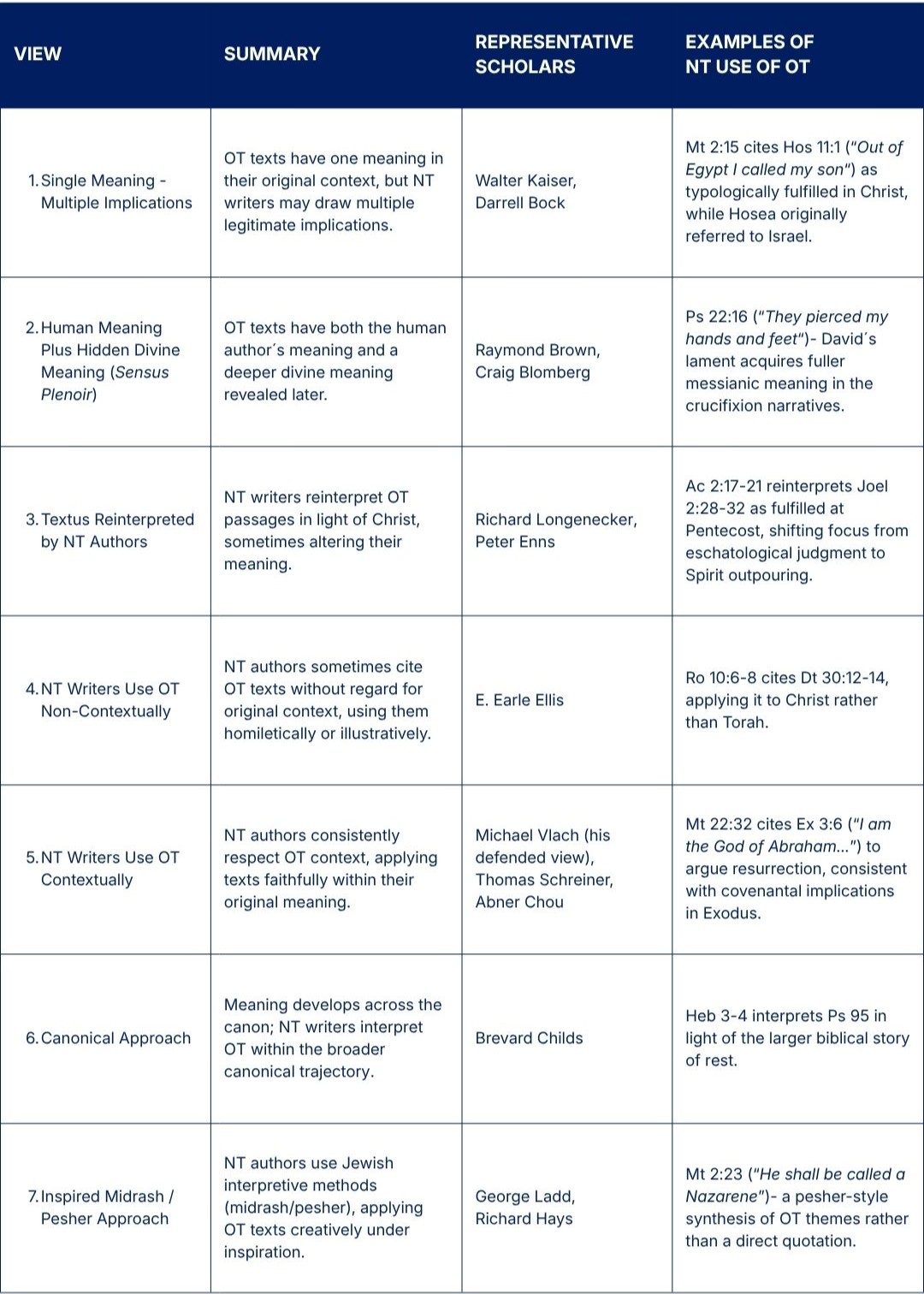
Michael Vlach’s 2021 book The Old in the New outlined seven major views/ approaches on how New Testament (NT) authors use Old Testament (OT) texts. He described each position but also dealt with all the passages. Above is a concise overview of each position, good and bad, with representative scholars and examples.
The View of This Article
It is my strong opinion that the vast majority of the readership of the Voice magazine—because of their belief in the inerrancy of the Bible; the literal (normal), grammatical-historical interpretation of Scripture; the concept of progressive revelation; and the distinctions between Israel and the Church; and because they are Dispensational in their approach to the storyline of the Bible (Dispensational in their theology)—would identify with the “Single Meaning-Multiple Significances,” or, “Consistent Contextual Use of the OT by the NT Writers” approach.
This is similar to that of Walter Kaiser and Abner Chou and is held by Michael Vlach and this writer (Burggraff). Vlach briefly summarizes this approach:
In sum, I believe the NT writers and persons consistently quoted and used the OT in a contextual manner. Whether by explaining the meaning of an OT passage, or drawing implications or significances from an OT text, the NT persons and authors quoted the OT in ways consistent with the original meanings of the OT authors.[27]
Vlach lists thirteen ideas/principles behind the understanding of this view and then devotes several chapters explaining the view (over 110 pages, with examples of OT/NT passages). I will highlight several principles we must bear in mind (from that list of thirteen) for our understanding of the NT use of the OT.
The writers of the Bible, both in the OT and NT, wrote under inspiration of the Holy Spirit; there is a human and divine author (i.e., “dual authorship”) for each passage of Scripture.
- For each passage in the Bible, including those in the OT, there is one, and only one, meaning. This affirms Article VII of the “Chicago Statement on Hermeneutics” which says: “We affirm that the meaning expressed in each biblical text is single, definite and fixed. We deny that the recognition of this single meaning eliminates the variety of Application.”
- Meaning is linked with authorial intent; thus, meaning is located in what an author meant.
- Under inspiration, the meaning of an OT passage from the human author is God’s meaning—there are no hidden or additional divine meanings in a text beyond what the human author intended (i.e., no sensus plenior).
- The confluence of human and divine authorship does not necessitate double and hidden meanings; instead, what the human author intended is what God intended at that point in a text.
- Progress of revelation makes the theory of fuller or hidden meaning or sensus plenior unnecessary; when God desired to add additional revelation, He did so through inspiring later authors of Scripture to write that revelation.
- In addition to meaning, a Bible pas- sage can have implications that include significances and applications that stem from the meaning an author intended in a text.
- The fact that God understands all implications and applications of an OT passage that the OT author did not foresee does not mean there are hidden meanings in an OT text.
- When the NT writers quote or allude to the OT writings, they are not just concerned with meaning; at times they also are drawing upon implications and applications; context will determine whether a NT writer is emphasizing OT meaning or significance.
- When there is implication or significance drawn from an OT passage in the NT, this is consistent with the meaning of the OT author and follows the trajectory of an OT author’s meaning.
Summary of How the NT Writers Used the OT
If we affirm the above principles, the NT writers then used OT passages in the following ways.
Direct Fulfillment
OT prophecies explicitly fulfilled in Christ or the Church. (The OT text has no contemporary referent but instead points to a direct fulfillment of an OT prophecy or promise in a specific event or person in the NT.)
Example: Isaiah 53 fulfilled in Christ (1Pe 2:22-24).
Typological Fulfillment
OT persons, events, or institutions serve as types pointing to greater realities in Christ.
Example: Israel’s exodus (Hos 11:1) typologically fulfilled in Jesus’ return from Egypt (Mt 2:15).
Analogical/Illustrative Use
OT passages used as analogies or illustrations without altering their original meaning.
Example: Paul’s use of Abraham’s faith in Romans 4.
Application of OT Principles
NT writers apply OT moral or theological principles to NT contexts.
Example: Paul citing Deuteronomy 25:4 (“Do not muzzle the ox”) in 1 Corinthians 9:9 to support fair treatment of ministers.
Eschatological Reapplication
OT eschatological promises re-applied to Christ’s kingdom and future hope.
Example: Acts 15:16–17 citing Amos 9:11–12 about Gentile inclusion.
Midrashic/Expository Use
NT authors sometimes expand or interpret OT texts in a way similar to Jewish midrash.
Example: Hebrews’ extended exposition of Psalm 95.
Allusions and Echoes
Subtle references to OT language or themes without direct quotation.
Example: John’s Gospel echoing Genesis 1 (“In the beginning…”).
Which leads us to make the following observations:
NT authors use the OT in diverse ways—not just prediction/fulfillment but also typology, illustration, and theological application.
Christ is the center: whether direct prophecy or typological pattern, the OT finds its climax in Jesus.
Continuity and development: NT writers respect the OT’s original meaning while showing how it fits into the larger canonical story of Scripture (i.e., the Bible’s storyline).
Flexibility: No single method explains all NT uses; instead, multiple categories are needed (i.e., an eclectic approach).
Conclusion
Jesus’ use of the OT in the Gospel accounts, whether by direct quotations or allusions to the OT, demonstrated the authority of the OT as the Word of God. Under the inspiration and superintendence of the Divine Author (Jn 14:26; 15:26-27; 16:12-15; 1Co 2:10-13; 2Pe 1:20-21), the NT writers demonstrated a connecting link in meaning between the testaments through the contextual uses of the OT in the NT. We’ve seen that the NT writers, under the inspiration of the Holy Spirit, used the OT in a variety of ways. Thus, the NT did not change or reinterpret the meaning of the revelation previously given by God.
The NT writers viewed the new era in Jesus to be a continuation of the storyline presented in the OT, not a reinterpretation of the story. Jesus is the center of the story and the means for the fulfillment of all things. But there is no reinterpretation, transcending, or trans- forming of the OT narrative. Jesus and the writers of the NT did not provide us a method of hermeneutics that gives us freedom to change (as Ladd and other non-Dispensationalists propose) or reinterpret the authorial intended meaning of the OT passages by their use of those passages in the NT. The NT builds upon the message of the OT, sometimes offering new information, but not offering reinterpretations.
ENDNOTES
[1] Dictionary of the New Testament Use of the Old Testament, eds. G.K. Beale, D.A. Carson, Benjamin L. Gladd, and Andrew D. Naselli (Grand Rapids: Baker Academic, 2023), xv. I described the work as “massive” – it’s 964 pages. Consider another lengthy work, the Commentary on the New Testament Use of the Old Testament, eds. G.K. Beale and D. A. Carson (Grand Rapids: Baker, 2007); it’s over 1,230 pages in length. Dozens of scholars contributed to each volume, demonstrating the interest the field attracts today. The length of these two works alone, plus other works to be cited in this article, demonstrates that any in-depth study of the topic is far beyond the scope of this article.
[2] Charles Ryrie, Dispensationalism (Chicago: Moody, 2007; reprint and update of Dispensationalism Today, 1966), 48; see esp. 46-48, and 143-168.
[3] W. Edward Glenny, “The Israelite Imagery of 1 Peter 2,” in Dispensationalism, Israel and the Church, eds. Craig A. Blaising and Darrell L. Bock (Grand Rapids: Zondervan, 1992), 156.
[4] Two resources that are helpful here are Abner Chou, The Hermeneutics of the Biblical Writers (Grand Rapids: Kregel Academic, 2018), and David L. Turner, Interpreting the Gospels and Acts: An Exegetical Handbook (Grand Rapids: Kregel Academic, 2019).
[5] Roger Nicole, “New Testament Use of the Old Testament,” in Rightly Divided: Readings in Biblical Hermeneutics, ed. Roy B. Zuck (Grand Rapids: Kregel, 1996), 183.
[6] Michael Vlach, The Old in the New: Under- standing How the New Testament Authors Quoted the Old Testament (The Woodlands, TX: Kress Biblical Resources, and Sun Valley, CA: The Master’s Seminary Press, 2021), vi.
[7] Nicole, “New Testament Use of the Old Testament,” 183.
[8] See Beale and Carson, Commentary; Kugel, James L. and Rowan A. Greer, Early Biblical Interpretation (Philadelphia: Westminster Press, 1986); and especially Abner Chou, The Hermeneutics of the Biblical Writers: Learning to Interpret Scripture from the Prophets and Apostles (Grand Rapids: Kregel Academic, 2018).
[9] John W. Wenham, Christ and the Bible, 3rd ed. (Eugene, OR: Wipf & Stock, 2009), 17-18.
[10] Roger Nicole, “Old Testament Quotations in the New Testament,” in Hermeneutics, ed. Bernard Ramm (Grand Rapids: Baker, 1971), 46-47.
[11] Roy B. Zuck, Basic Bible Interpretation (Wheaton, IL: Victor Books, 1991), 252.
[12] Roy Zuck notes that “a number of statements made by God in the Old Testament are called Scripture by the New Testament writers, thereby demonstrating that they identified the Old Testament with God’s words,” ref. Ro 9:17, citing Ex 9:16; Gal 3:8 citing Ge 12:3. See Basic Bible Interpretation, 252-53.
[13] Ronald Youngblood, “Old Testament Quotations in the New Testament,” in Rightly Divided ed. by Zuck, notes: “It is generally agreed that the New Testament never quotes from the Apocrypha, though some have detected apocryphal allusions here and there. Jude 14 quotes the pseudepigraphal 1 Enoch 1:9. Such quotations and allusions do not confer canonical status on the Apocrypha and Pseudepigrapha, however, any more than Paul’s quotation of Aratus in Acts 17:28.”
[14] Nicole, “New Testament Use of the Old Testament,” 184.
[15] Richard N. Longenecker, Biblical Exegesis in the Apostolic Period, 2nd ed. (Grand Rapids: Eerdmans, 1999), 49.
[16] Nicole, “New Testament Use of the Old Testament,” 195.
[17] Wenham, Christ and the Bible, 97-98; see also Nicole, “New Testament Use of the Old Testament,” 188-190.
[18] Nicole, “New Testament Use of the Old Testament,” 190-195.
[19] Wenham, Christ and the Bible, 98.
[20] Longenecker, Biblical Exegesis, 14-35.
[21] Ibid., 39.
[22] Bernard Ramm, Protestant Biblical Interpretation, 24.
[23] Benjamin Merkle, Discontinuity to Continuity: A Survey of Dispensational & Covenantal Theologies (Bellingham, WA: Lexham Press, 2020), 8-9. Italics mine for emphasis.
[24] George E. Ladd, “Historic Premillennialism,” in The Meaning of the Millennium: Four Views, ed. Robert G. Clouse (1977), 20-21,27.
[25] See Kenneth Gentry, He Shall Have Dominion: A Postmillennial Eschatology, 1992, p. 156. This is similarly affirmed by current covenantal writers as expressed in Covenantal and Dispensational Theologies: Four Views on the Continuity of Scripture, eds. Bret E. Parker and Richard J. Lucas (Downers Grove, IL: IVP, 2022).
[26] Michael J. Vlach, Dispensationalism: Essential Beliefs and Common Myths (Los Angeles, CA: Theological Studies Press, 2017), 87-89; and his Dispensational Hermeneutics: Interpretation Principles that Guide Dispensationalism’s Understanding of the Bible’s Storyline (Theological Studies Press, 2023), 35-39. See also Paul Feinberg, who also argues that Dispensationalists are not calling for OT priority over the NT. Feinberg states, “[T]he OT economy must not be forced upon the New. There must be the allowance for genuine progress in divine revelation and salvation history. On the other hand, it is equally as egregious an error to impose the NT on the Old, as though there was some need to ‘Christianize’ it.” Paul Feinberg, “Hermeneutics of Discontinuity,” in Continuity and Discontinuity: Perspectives on the Relationship Between the Old and New Testaments, ed. John S. Feinberg (Wheaton: Crossway, 1988), 127.
[27] Vlach, The Old in the New, 61. I highly recommend this book as a must-read for my seminary students and, I believe, for preachers as well. Every OT quote (and identifiable allusion) in the NT is addressed; as such, it is an ideal “handbook” for preachers and teachers.
Copyright VOICE Magazine, used by permission.
Issue: March/April 2026.